Buying guide
Backpacking stoves: canister, integrated, liquid fuel and alcohol compared
A light stove that boils water fast is enough for most trips. Here is how the four types compare, and which one suits the way you hike.
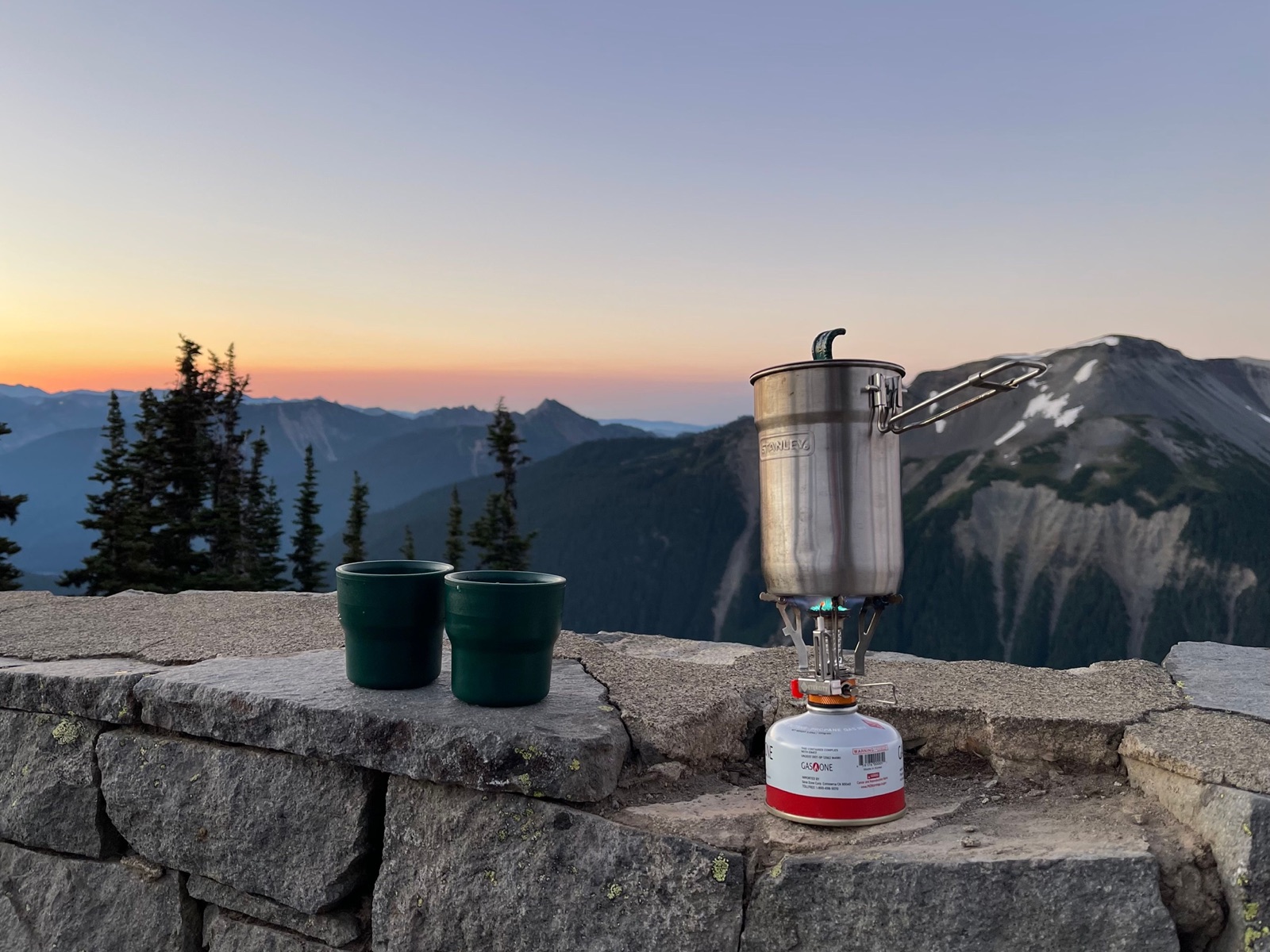
A backpacking stove has one main job: boil water quickly and reliably for dinner, breakfast and coffee, then disappear into your pack. The choice is between four types, and it comes down to weight, the weather you hike in, and whether you cook or just add boiling water to a meal.
This guide compares canister, integrated, liquid-fuel and alcohol stoves, explains the specs that matter, and covers how to use and care for a stove on the trail. If you camp next to your car, the camping stoves guide covers two-burner propane stoves instead.
What a backpacking stove needs to do
On the trail, a stove is judged by a few things: how much it weighs with its fuel, how fast it boils water, how well it copes with wind and cold, and how much fuel it burns doing so. Simmering matters only if you cook from raw ingredients; for freeze-dried meals and oatmeal, a fast boil is everything.
Makers publish weights and boil times, but treat boil times as best-case. MSR says its boil times are measured in average laboratory conditions; wind, cold and a half-empty canister slow a stove down.
Types of backpacking stove
Canister stoves
A small burner that screws straight onto the top of a pressurized fuel canister, usually an isobutane-propane mix. They light quickly, need no priming and adjust easily. They are also among the lightest stoves you can buy: MSR lists its PocketRocket 2 at 2.6 oz (73 g), with a boil time of about 3.5 minutes per liter in its tests.
The downsides, in MSR's own words: canisters can't be refilled, and these stoves don't perform well in extreme cold. Some models add a pressure regulator; MSR says the one in its PocketRocket Deluxe, at 2.9 oz (83 g), gives consistently faster boil times than unregulated stoves.

Remote-canister stoves
A variant where the burner sits low on folding legs and connects to the canister with a fuel hose. The low, wide stance is more stable under bigger pots, and because the canister sits away from the flame, MSR says these remote-burner designs are the ones that can safely be used with a windscreen. MSR's WindPro II weighs 6.6 oz (187 g).

Integrated stove systems
A burner, a heat-exchanger pot (one with fins on the base that catch more of the flame's heat) and often an insulated cozy, all designed to lock together. MSR describes its systems as "hyper-fast and windproof" and says the enclosed design shields the burner from wind, which saves fuel. They are heavier than a bare canister stove. MSR's Reactor 1.0L system weighs 14.7 oz (417 g) and boils a liter in about 3.5 minutes in MSR's testing; the WindBurner Personal 1.0L weighs 15.3 oz (433 g). The trade-off: MSR says its Reactor and WindBurner burners are not compatible with other pots.
Liquid-fuel stoves
These burn white gas (and on multi-fuel models, kerosene or unleaded gasoline) from a refillable bottle that you pressurize with a small pump. MSR says they "operate far better than canister stoves in extreme cold", which is why they are popular for winter trips and for travel where canisters are hard to find. They need priming (preheating the burner with a little burning fuel) before each use and occasional cleaning. MSR's WhisperLite Universal weighs 11.2 oz (318 g) on white gas and can also run on canisters.
Alcohol stoves
The simplest stove of all: a small cup that burns denatured alcohol or a similar alcohol-based fuel. They are silent, nearly unbreakable and very light, and the fuel is easy to find. They are also slow. Trangia's guide to its spirit burner gives about 10 minutes to bring a liter to a boil and about 25 minutes of burning from roughly 100 ml of fuel, the most it says to put in the burner (two-thirds full). Trangia recommends a preheater for its burner from about 41°F (+5°C) and below. Trangia says never to add fuel until the flame is completely out and the burner has cooled enough to hold in your hand. Refill it away from any other flame.
Backpacking stove comparison
| Type | Fuel | Example weight (maker's figure) | Strengths | Weak spots |
|---|---|---|---|---|
| Upright canister | Isobutane-propane canister | 2.6 oz (73 g), MSR PocketRocket 2 | Light, simple, quick to light | Cold weather, wind, non-refillable canisters |
| Remote canister | Isobutane-propane canister | 6.6 oz (187 g), MSR WindPro II | Stable, can use a windscreen | Heavier than upright |
| Integrated system | Isobutane-propane canister | 14.7 oz (417 g), MSR Reactor 1.0L system | Fast and wind-resistant, efficient | Heavy, burner tied to its pot |
| Liquid fuel | White gas, some multi-fuel | 11.2 oz (318 g), MSR WhisperLite Universal on white gas | Best in deep cold, refillable | Priming, maintenance, heavier |
| Alcohol | Denatured alcohol or similar | Usually a few ounces | Cheap, silent, very simple | Slow, hard to control, fire rules |
What to look at when choosing
Weight with fuel, not just the stove
A 2.6 oz stove still needs a canister, and canisters are heavy for their size. Compare complete kits for the length of your trip: stove, fuel, pot and windscreen. Over a long trip, a more efficient system can carry less fuel and come out lighter.
How much fuel to carry
MSR's method is to multiply the number of people by the number of hot meals, add hot drinks, and treat the total as liters of water to boil. Then use the stove's efficiency figure: MSR lists the PocketRocket 2 at about 2 liters boiled per ounce (28 g) of fuel. MSR adds that low temperatures, melting snow and wind can require three to four times the baseline.
Cold and altitude
According to MSR, upright canister stoves usually work down to about 20°F, and efficiency drops below that; MSR calls stove systems and liquid-fuel stoves the go-tos for winter. At altitude, water boils at a lower temperature, so boil-only meals still work but raw food takes much longer to cook.
Wind
MSR says a 5 mph wind can cause as much as three times more fuel use for open-flame stoves such as the PocketRocket. Integrated systems are shielded from wind. With an upright canister stove, use rocks or your body as a wind block, not a windscreen that wraps around the canister: MSR calls a windscreen unsafe with any non-remote-burner backpacking stove.
Simmering and pot size
If you cook pasta, rice or fresh food, look for a wide burner head and a valve with a good low setting. If you only boil water, ignore simmer claims. Match your camp cookware to the stove: a narrow canister stove is best with a small, light pot of one liter or so.
Which backpacking stove suits you
- Weekend backpacking in 3-season weather: an upright canister stove. Light, simple and fast.
- Solo hikers who only boil water: an integrated system for speed and wind resistance, or an alcohol stove if weight and silence matter more than speed.
- Cooking real meals for two or more: a remote-canister stove with a wider pot.
- Winter, high altitude or international travel: a liquid-fuel stove.
- Fire-restriction season: check what the land manager allows before you go; rules on stoves differ by park and forest (see camping stoves for an example).
Water is the other half of trail cooking; see our guide to water filters for backpacking for treating it.
Safe use on the trail
Never cook in a tent or vestibule
MSR's WhisperLite Universal manual states: "This stove can produce carbon monoxide, which is poisonous and has no odor. Using it in an enclosed space can kill you. Never use this stove in an enclosed space such as a camper, tent, car, or home." The DragonFly manual adds vestibules to the list. The manual also warns that use within any enclosure can cause fire, burns, severe injury or death. Cook in the open, a few steps from the tent, even when it rains.
Set up on stable ground
Place the stove on a flat rock or cleared, firm ground so a full pot can't tip. MSR's manuals ask you to keep combustibles at least 4 feet from a lit stove and children at least 10 feet away. Check that the canister thread or fuel line is tight before you light it, and light the stove with your face and hands clear of the burner.
Care on and off the trail
- Let the burner cool before packing it, and store it in its case so the pot supports don't puncture anything.
- Keep the fuel jet clean; liquid-fuel stoves usually come with a cleaning tool, and the manual explains how to use it.
- Check O-rings and seals before each trip, and carry the maker's spare-parts kit on long trips with a liquid-fuel stove.
- Store canisters cool and out of direct sun, and recycle empties according to local rules.
- Follow the instructions for your specific stove: priming, fuel types and maintenance differ between models.
More on cooking outdoors is in the camp kitchen section.
Questions
What is the lightest kind of backpacking stove?
Small upright canister stoves and alcohol burners are the lightest. MSR, for example, lists its PocketRocket 2 canister stove at 2.6 oz (73 g), not counting the fuel canister.
Do canister stoves work in cold weather?
Less well. MSR says upright canister stoves usually work down to about 20°F and lose efficiency below that, and it names liquid-fuel stoves and integrated stove systems as the go-tos for winter.
How much fuel do I need for a backpacking trip?
Estimate how many liters of water you will boil (people times hot meals, plus hot drinks), then use your stove maker's figure for liters boiled per ounce of fuel. MSR notes that cold, wind and melting snow can take three to four times that baseline.
Can I cook in my tent vestibule when it rains?
Stove makers say no. MSR's manuals warn that stoves produce odorless carbon monoxide and should never be used in an enclosed space such as a tent, vestibule, camper, car or home.
Read next
Backpacking checklist: what to pack for a night or a weekend on the trail
Everything you carry on your back for an overnight or weekend trip, grouped by system, with the Ten Essentials built in.
Camping stoves: how to choose a stove for the campsite
Two-burner propane, single-burner butane or a backpacking stove: what each type cooks well, what the specs mean and how to use one safely.
Camp cookware: how to choose pots, pans and cook sets
Material decides most of it: what each one cooks well, what it weighs and how to look after it, from a titanium mug to a cast iron dutch oven.