Buying guide
Camp cookware: how to choose pots, pans and cook sets
Material decides most of it: what each one cooks well, what it weighs and how to look after it, from a titanium mug to a cast iron dutch oven.
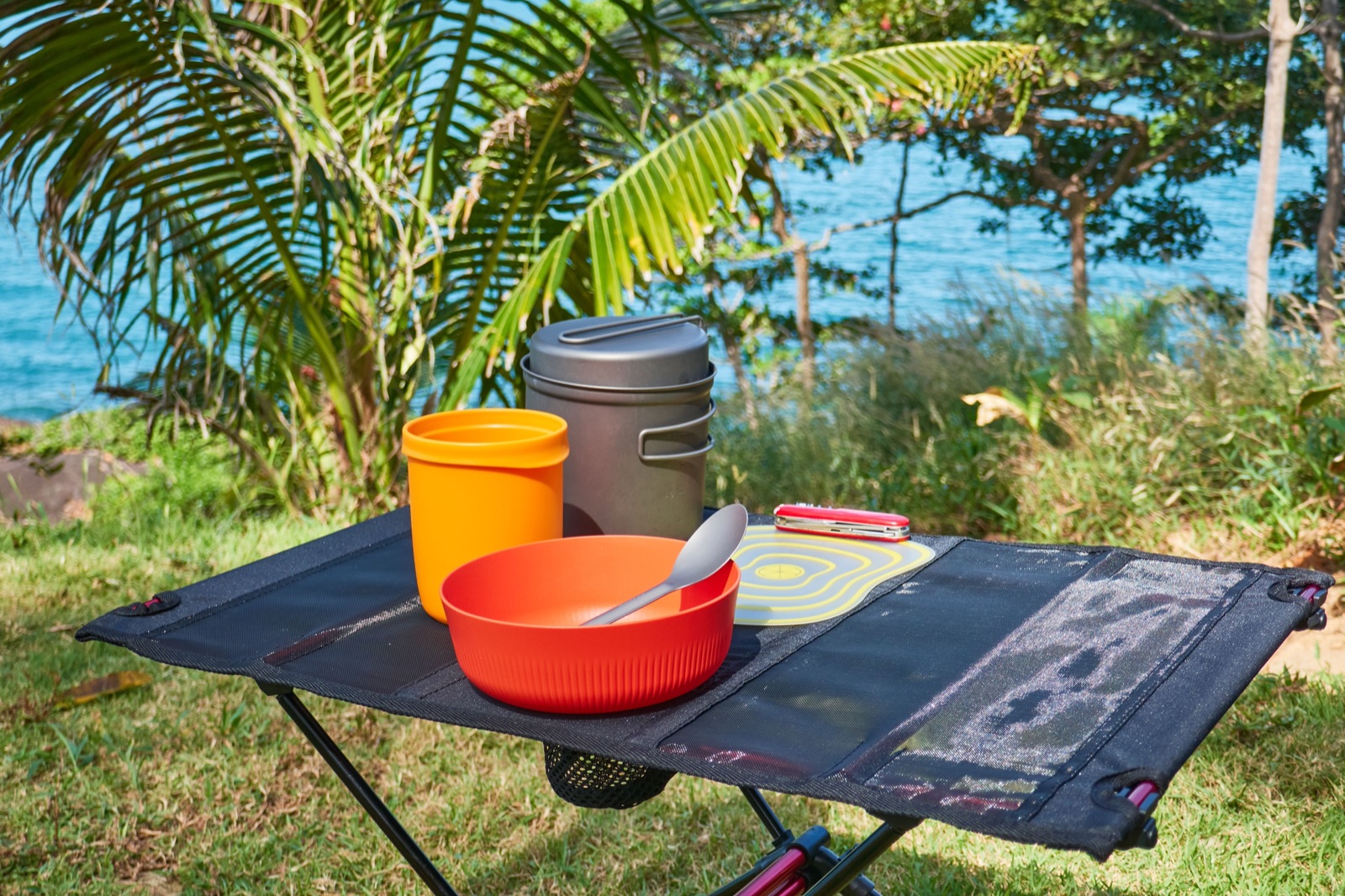
Camp cookware ranges from a single titanium mug that doubles as a pot to a full camp kitchen with skillets, a coffee pot and a cast iron dutch oven. Choosing well comes down to three questions: how many people you cook for, whether you carry the kitchen or drive it to camp, and whether you boil water or cook real meals.
This guide covers the materials, the kinds of cook sets, the sizes that suit different groups, and how to clean and store camp cookware so it lasts.
What camp cookware has to do
Home cookware stays on one stove. Camp cookware has to pack small, survive being dropped on rocks, work on a narrow stove burner or over coals, and be easy to clean with little water. Backpacking cookware adds one more demand: every ounce counts. That is why most outdoor pots nest inside one another and have folding handles, and many have lids that double as strainers.
Cookware materials compared
Aluminum and hard-anodized aluminum
Aluminum spreads heat quickly and evenly, which makes it the easiest material to cook on without scorching. MSR calls hard-anodized aluminum "the cookware of choice for all-around backcountry use" and says the anodizing process makes it very durable. Many aluminum pots and pans add a nonstick coating; MSR's ceramic nonstick is described as PTFE- and PFOA-free. Like any nonstick pan, MSR says to use only non-metal utensils on it.
Stainless steel
MSR describes stainless steel as "by far the toughest and most scratch-resistant" of the materials it uses, though it is heavier than aluminum and titanium. It does not conduct heat well, which can lead to hot spots and burned food. Stainless suits group cooking, rough handling and car camping, and it is easy to scrub clean.
Titanium
Titanium is the lightweight choice. MSR says it is 45% lighter than steel, stronger than aluminum and corrosion-resistant. Titanium pots have thin walls and heat quickly, but MSR says they tend to develop hot spots, so they are ideal mainly for boiling water rather than real cooking. A titanium mug or small pot is a common pairing with a canister stove.
Cast iron
Heavy, slow to heat and superb at holding heat. Cast iron is for car camping: skillets for breakfast, and the camp dutch oven for stews, chili and baking over coals. Lodge's camp dutch ovens have three short legs that hold the pot above the heat and let air circulate, a flanged lid that holds hot coals and flips over to use as a griddle, and a wire bail for lifting or hanging the pot.

Collapsible silicone pots
Pots with a rigid aluminum base and silicone sides that fold flat save a lot of space. They have rules: Sea to Summit says its X-Pot must be fully popped up before use so flame does not touch the silicone, that the stove's flame should be much smaller than the base, that the base must stay covered with water or other liquid while heating, and that the pot is not for campfires or induction cooktops.
Material comparison
| Material | Weight | Heat spread | Durability | Best for |
|---|---|---|---|---|
| Hard-anodized aluminum | Light | Even | Good; coatings need care | All-round backpacking and car camping |
| Stainless steel | Heavier | Uneven, hot spots | Very tough | Groups, rough use, car camping |
| Titanium | Lightest | Uneven, hot spots | Tough, corrosion-resistant | Boiling water, ultralight trips |
| Cast iron | Very heavy | Slow but holds heat | Very durable with care | Car camping, coals and campfires |
| Collapsible silicone with aluminum base | Light | Base only | Must be used carefully | Packing small, boil-and-simmer meals |
Cook sets, mess kits and single pieces
Mess kits
A mess kit is a one-person set: a small pot or pan, a lid, and often a cup or bowl, all nesting together. It is the simplest way to start, especially for a first backpacking trip.
Cook sets
A cookset (camp cook set) bundles two or more pots, a lid or two, sometimes a frying pan, bowls and mugs, sized for two to four people. Many sets nest around a fuel canister or a small stove, so the whole kitchen packs as one unit. Check that the largest pot fits your stove's pot supports and that the set nests with your stove inside.
Choosing pot size
Size the main pot to the group and the menu. For one person boiling water for dehydrated meals, a pot of about a liter is usually enough. Two people usually want 1.5 to 2 liters; groups of four or more cooking pasta or stew usually want a larger pot plus a pan. Wider pots are more stable and heat more efficiently on a wide burner; tall narrow pots suit small canister stoves and integrated systems.
Handles, lids and small details
Small details decide whether a pot is pleasant to use. Folding handles should lock firmly open and stay cool enough to hold; pots without handles need a separate pot grip, which is one more thing to lose. A lid with strainer holes makes draining pasta easy and saves fuel while water heats. Measurement marks inside the pot help with dehydrated meals that need an exact amount of water. Before you buy, check the packed size against the space you actually have in your pack or kitchen box.
Utensils and extras
A long-handled spoon or spork, a pot grip if your pot has no handles, a small spatula for a nonstick pan, and a lightweight cutting board cover most needs. Car campers can add a coffee pot, a kettle, tongs and a full knife and cutting board set.
Which camp cookware suits you
- Solo backpacking, boil-only meals: a titanium or aluminum pot of about a liter, or a large titanium mug, plus a long spoon.
- Two backpackers who cook: a hard-anodized aluminum cook set with a 1.5 to 2 liter pot and a small nonstick pan.
- Families car camping: stainless or aluminum pots, a large skillet, a kettle and, if you like campfire cooking, a camp dutch oven.
- Tight on space: collapsible silicone pots, used exactly as the maker instructs.
Cookware has to match the stove it sits on. See our guides to camping stoves and backpacking stoves, and for what to cook, camping meals.
Cleaning and care
Washing up at camp
Scrape plates and pots clean and pack out food scraps rather than leaving them. Leave No Trace recommends washing dishes about 200 feet from streams and lakes, straining the dishwater to remove food bits and packing those out, then scattering the strained water widely.
Caring for each material
- Nonstick coatings: use non-metal utensils, and MSR suggests a small towel between pots when nesting them.
- Collapsible pots: Sea to Summit says not to put its X-Pot in a dishwasher and to avoid the scouring side of a sponge on the silicone.
- Cast iron: Lodge's care steps for its camp dutch oven are to scrape out the food, wash by hand with hot water (a small amount of mild detergent is fine), dry it thoroughly, rub on a very light layer of oil while it is still warm, and store it with the lid ajar so moisture can't collect.
- Everything else: dry pots fully before storing them at home, and follow the care instructions for your specific set.
More on stoves, coolers and cooking outdoors is in the camp kitchen section.
Questions
What is the best material for camp cookware?
It depends on how you cook. MSR calls hard-anodized aluminum the cookware of choice for all-around backcountry use; titanium is lightest and best for boiling water, stainless steel is the toughest, and cast iron suits car camping and campfire cooking where weight does not matter.
Is titanium cookware worth it for backpacking?
If you mostly boil water, yes: titanium is very light and corrosion-resistant. MSR notes that titanium pots tend to develop hot spots, which makes them less suited to frying or simmering real meals.
What is a mess kit?
A mess kit is a small nesting set for one person, usually a pot or pan, a lid, a cup or bowl and sometimes utensils, that packs into itself. Cook sets are the larger versions for two or more people.
Can I use soap to clean a cast iron dutch oven?
Lodge says a small amount of mild detergent is acceptable. Scrape out food, wash with hot water, dry the oven thoroughly and rub on a very light layer of cooking oil while it is still warm.
Sources (6)
- MSR — Backpacking cookware 101: titanium vs. aluminum vs. stainless steel
- MSR — The ultimate guide to MSR cookware
- Sea to Summit — Getting the best from your X-Pot
- Lodge Cast Iron — Cleaning and care: camp dutch oven
- Lodge Cast Iron — Cast iron camp dutch oven
- Leave No Trace — Principle 3: Dispose of waste properly
Read next
Backpacking stoves: canister, integrated, liquid fuel and alcohol compared
A light stove that boils water fast is enough for most trips. Here is how the four types compare, and which one suits the way you hike.
Camping stoves: how to choose a stove for the campsite
Two-burner propane, single-burner butane or a backpacking stove: what each type cooks well, what the specs mean and how to use one safely.
Camping meals: how to plan, pack and cook food at camp
A simple plan, a cold cooler and a few one-pot dinners: how to eat well at camp without spending the whole trip cooking.