Buying guide
Camping hammocks: how to choose a hammock to sleep in outdoors
Gathered-end, all-in-one hammock tents and lay-flat designs: what to compare, how to hang one and what you need to stay dry and warm.
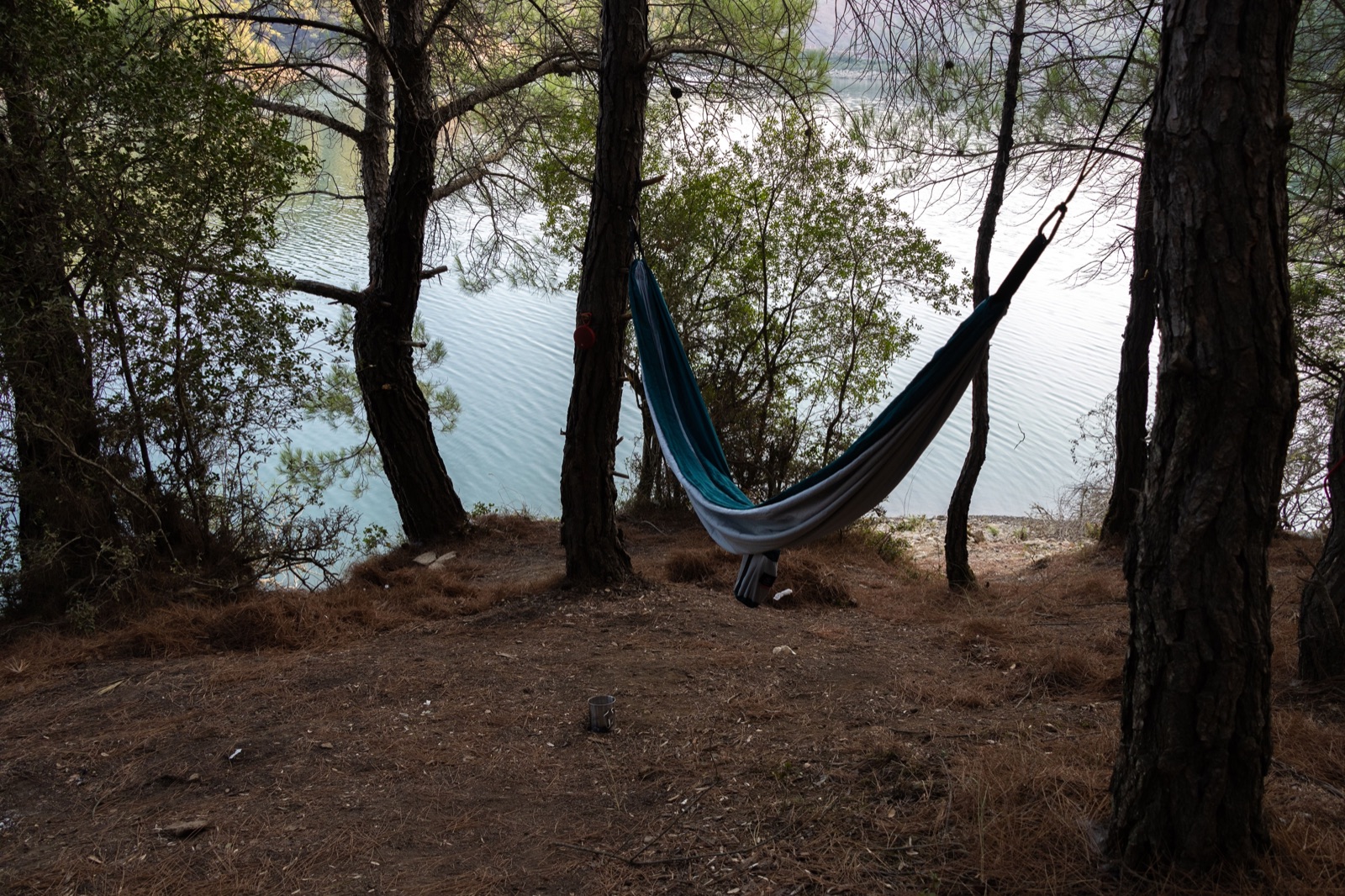
A camping hammock is a hanging bed you sleep in between two trees, used instead of a tent or alongside one. Off the ground, you don't need a flat, clear spot, and roots, rocks and puddles stop mattering. In exchange you need trees the right distance apart, a way to keep rain and bugs off, and insulation underneath. This guide covers the main types, what the specs mean and how to hang one well.
What a camping hammock needs to do
A day hammock only has to hold you while you nap in the sun. A hammock you sleep in overnight has to do the job of a whole shelter:
- Hold your weight safely, with straps that don't damage the trees.
- Let you lie nearly flat for hours.
- Keep bugs off, usually with a mosquito net.
- Keep rain off, with a tarp or rainfly hung above.
- Keep you warm, because the air moving under a hammock cools you even on mild nights.
Types of camping hammock
Gathered-end hammocks
The classic design: a rectangle of nylon gathered at each end onto a loop or carabiner. You lie diagonally across it to get almost flat. They are light, usually inexpensive and pack small. ENO's SingleNest, for example, lists a 400 lb capacity, a weight of about 16 oz, and 9 ft 6 in by 4 ft 10 in of 70-denier nylon. On its own, a gathered-end hammock has no bug net or rain cover, so for overnight trips you add both.
Hammock tents
A hammock tent (or camping hammock tent) is a gathered-end or asymmetric hammock with an integrated bug net and a matching rainfly, sold as one shelter. Kammok's Mantis is an example: Kammok lists an integrated bug net of 20D no-see-um mesh, a 15D ripstop rainfly with a 1,500 Sil/PU coating, a 120 by 56 in hammock body, a 500 lb maximum capacity and a trail weight of 2 lb 11.5 oz with the rainfly. All-in-one designs take the guesswork out of matching parts.
Lay-flat hammocks
Some designs use spreader bars or an inflatable pad sleeve to create a flatter platform, aimed at side sleepers and people who can't get comfortable on the diagonal. Haven Tents' Haven Tent lists a 24 by 78 in platform, a 285 lb capacity and a kit weight from 5 lb 11.3 oz (2,587 g), depending on which rainfly and spreader bars you choose. Lay-flat systems are heavier and need more setup than a plain hammock.
Netting hammocks and hammocks with stands
A netting hammock is woven from rope or mesh. It is airy for warm-weather lounging but gives no wind protection and leaves marks, so it is rarely used for sleeping overnight. A portable hammock and stand set lets you hang a hammock with no trees at all; stands are heavy, so they belong in car camping and backyards, not in a backpack.

Camping hammock types compared
| Type | Bug and rain protection | Weight | Sleeping position | Best for |
|---|---|---|---|---|
| Gathered-end | Add a net and tarp | Lightest | Diagonal | Backpacking, lounging |
| Hammock tent | Built in | Light to moderate | Diagonal | First-time hammock campers |
| Lay-flat | Usually built in | Heaviest | Flat, side sleeping | Side sleepers, car camping |
| Netting hammock | None | Light | Lounging | Warm-weather daytime use |
| Hammock with stand | None, unless added | Heavy | Varies | Yards, campsites without trees |
What to look at
Weight capacity
Every hammock lists a maximum load. Stay well under it and remember it covers you, your sleeping bag and anything else in the hammock. The examples here list 285 lb (Haven Tent), 400 lb (ENO SingleNest) and 500 lb (Kammok Mantis). Lighter, thinner fabrics usually carry lower ratings.
Length and width
A longer, wider hammock lets you lie at a flatter diagonal. Taller campers should look for longer bodies; the Kammok Mantis is listed at 120 in long, the ENO SingleNest at 9 ft 6 in.
Suspension
Straps that protect trees
Hang from flat webbing tree straps, not rope. Leave No Trace's hammock guide recommends straps 1 inch or wider, wrapped once around a tree at least 6 inches in diameter, to limit damage to the bark. Many parks have their own hammock rules, so check with the land manager before you hang.
Rain tarp or fly
Look for a tarp long enough to cover both ends of the hammock with a few inches to spare. Larger tarps give more storm protection and a dry spot to stand and change; smaller ones save weight.
Insulation
Your sleeping bag's fill is crushed flat underneath you, so it barely insulates there. Hammock campers add an underquilt, a quilt hung beneath the hammock, or slide a sleeping pad inside. See the sleep systems section for pads and bags.
How to hang a camping hammock
- Pick trees. Choose live, healthy trees at least 6 inches in diameter, as Leave No Trace advises, and look up for dead branches.
- Check the spacing. ENO suggests about 10 to 15 feet between trees for its standard hammocks with its straps.
- Wrap the straps around each trunk once and clip the hammock to them.
- Set the sag. ENO recommends an angle of about 30 degrees between the strap and the horizon, and a hanging height of no more than 18 inches above the ground once you are in it.
- Lie diagonally with your head on one side of the center line and your feet on the other.
- Hang the tarp over a ridgeline above the hammock and stake out its corners.
Follow the setup instructions for your own hammock; spacing and strap length differ between models.
Hammock camping and Leave No Trace
Hammocks can leave less trace than a tent, because nothing flattens the ground, but only if the trees are treated well. Leave No Trace's hammock guide suggests:
- Use wide webbing straps and a loose hang, wrapping each strap around the trunk once rather than several times.
- Prefer healthy trees with hard bark, and skip trees covered in lichen or with soft, damaged bark.
- Don't tie hammocks, tarps or lines to young or small trees, which can bend or break.
- Check with the local land manager first, because some parks and campgrounds limit or ban hammocks on their trees.
When you leave, take down every line and check for anything left behind.
Which camping hammock suits whom
- Curious beginners: a hammock tent with a built-in bug net and fly, so all the parts fit together.
- Backpackers in wooded country: a gathered-end hammock with a separate net, tarp and underquilt, matched to your conditions. Compare total weight with a backpacking tent.
- Side sleepers: a lay-flat hammock.
- Couples: two hammocks side by side, or a 2 person tent; most overnight hammocks are sized for one sleeper.
- Campers in treeless areas: a tent, or a hammock with a stand for car camping only.
Care
Wash the hammock body by hand or as the label says, and dry it before storing it. Inspect straps, loops and carabiners for fraying or cracks before each trip, and replace worn parts. For more shelter options, browse the tents section.
Questions
Can you sleep in a camping hammock all night?
Yes. Lying diagonally across a gathered-end hammock lets most people lie nearly flat, which is why makers like ENO suggest a hang angle of about 30 degrees. You also need insulation underneath, since a hammock compresses any sleeping bag below you.
What is a hammock tent?
A camping hammock with a built-in bug net and a rainfly or tarp, so it works as a complete shelter between two trees. Kammok's Mantis, for example, has a built-in, zippered bug net and a 15D rainfly.
How far apart should trees be for a hammock?
ENO suggests about 10 to 15 feet between trees for its standard hammocks with its straps, and 14 to 18 feet for spreader-bar models. Check the setup guide for your own hammock.
What kind of straps should I use to hang a hammock from trees?
Flat webbing straps at least 1 inch wide, as Leave No Trace recommends, wrapped around the trunk to protect the bark. Avoid thin rope or cord, which can cut into the tree.
Is a portable hammock with a stand good for camping?
A hammock stand lets you hang a hammock where there are no trees, such as a backyard or a campground pad. Stands are heavy, so they suit car camping rather than backpacking.
Read next
Sleeping bag temperature ratings: what comfort and limit mean
Comfort, limit and extreme explained, and how to turn the number on the bag into a warm night at the campsite you are going to.
Backpacking tents: how to choose a light shelter you will carry
Weight, floor space, pole design and fabric: what to compare before you buy a tent that rides on your back for miles.
2 person tents: how to choose one for two people and their gear
Floor width, doors, weight and weatherproofing: what decides whether a two-person tent really fits two people.